

Search behavior has evolved rapidly over the past several years. Traditional search engine optimization once focused almost entirely on rankings and traffic.
Today, internet marketing strategies need to account for how search engines and AI platforms deliver information directly to users. Two emerging concepts, Answer Engine Optimization and Generative Engine Optimization, are reshaping how businesses approach digital visibility.
Understanding the distinction between these strategies allows organizations to position themselves effectively in an increasingly AI-driven environment.
Understanding Answer Engine Optimization
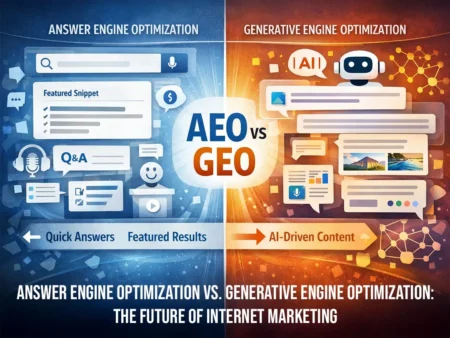
AEO, or Answer Engine Optimization, is about organizing content so search engines can find and display direct answers in search results. Modern search engines often provide immediate answers in featured snippets, knowledge panels, and voice search results, rather than requiring users to click multiple links.
AEO puts clarity, accuracy, and structure first. Search algorithms need to be able to find short definitions, step-by-step instructions, and frequently asked questions in the content. Using structured headings, short paragraphs that explain the content, and schema markup increases the likelihood of getting a position zero listing.
For internet marketing professionals, AEO represents an evolution of traditional SEO. Instead of optimizing solely for ranking position, the objective is to secure visibility within the answer itself. This approach strengthens authority and brand recognition, even when click-through rates vary.
The Rise of Generative Engine Optimization
Generative Engine Optimization (GEO) looks at a new trend in how people search. AI platforms now make conversational responses that combine information from many sources. These systems don’t just show 10 blue links; they provide detailed explanations based on patterns in learned data and on content that has been cited.
GEO’s main goal is to make a brand look like a trustworthy, authoritative source that AI systems are more likely to use when making decisions. To achieve this, one must possess extensive subject-matter knowledge and communicate with authority. Long-form content, research-based insights, clear entity associations, and a strong digital footprint all contribute to GEO’s success.
GEO, on the other hand, rewards thorough, context-rich content, while AEO values short answers. Companies must demonstrate that they are leaders in their field. GEO requires internet marketers to think more strategically about how to combine branding, content authority, and technical optimization.
Key Differences Between AEO and GEO
Both strategies want to make your digital presence more visible, but they do so in very different ways. Answer Engine Optimization is aimed at structured extraction in standard search engines. Generative Engine Optimization is all about AI-driven response systems that put together and make sense of information.
Formatting, clarity, and structured data are very important for AEO. GEO relies more on authority, semantic relevance, and regular publishing. AEO helps a brand show up in direct answer boxes. GEO increases the likelihood that an AI-generated explanation will include a brand.
Forward-thinking internet marketing strategies utilize both of these methods. It’s not enough to just optimize for rankings anymore. Businesses need to ensure their content can be accessed, summarized, and cited across various digital settings.
Why This Matters for Modern Internet Marketing
As users look for faster, easier ways to find information, the competitive landscape continues to evolve. Voice search, AI chat interfaces, and conversational search tools are changing the way people find businesses. Companies that change early can get a clear edge.
A comprehensive digital strategy is necessary in markets like Clearwater, where service providers are increasingly competing with one another. Internet marketing now has to take into account traditional SEO, local visibility, answer extraction, and AI-generated responses. Companies that don’t pay attention to these changes could lose business to more flexible competitors.
Businesses set themselves up for long-term relevance by creating authoritative content that clearly answers common questions and demonstrates their depth in their field.
Frequently Asked Questions
What is the primary goal of Answer Engine Optimization?
The primary goal of AEO is to structure content so that search engines can extract and display it as a direct answer in featured results or voice responses.
How does Generative Engine Optimization differ from traditional SEO?
GEO extends beyond ranking factors. It emphasizes building authority and comprehensive expertise so that AI systems are more likely to reference or synthesize a brand’s content in generated responses.
Is one strategy more important than the other?
Both strategies serve distinct purposes. A balanced internet marketing plan integrates AEO for direct search visibility and GEO for AI-driven discovery.
Can small businesses benefit from these strategies?
Yes. Small and mid-sized businesses can gain substantial visibility by structuring their content effectively and demonstrating topical authority in their niche.
Preparing for the Future of Search
Digital marketing continues to evolve rapidly. Businesses that embrace both Answer Engine Optimization and Generative Engine Optimization will be better positioned to maintain visibility as technology advances. Structured clarity and authoritative depth must work together within a cohesive internet marketing strategy. Organizations seeking guidance on implementing these advanced strategies can benefit from partnering with experienced professionals. For businesses in Clearwater looking to strengthen their digital presence, working with experts such as Affordable SEO FL can provide strategic direction aligned with modern search behavior.
Picture Source: AI-generated