

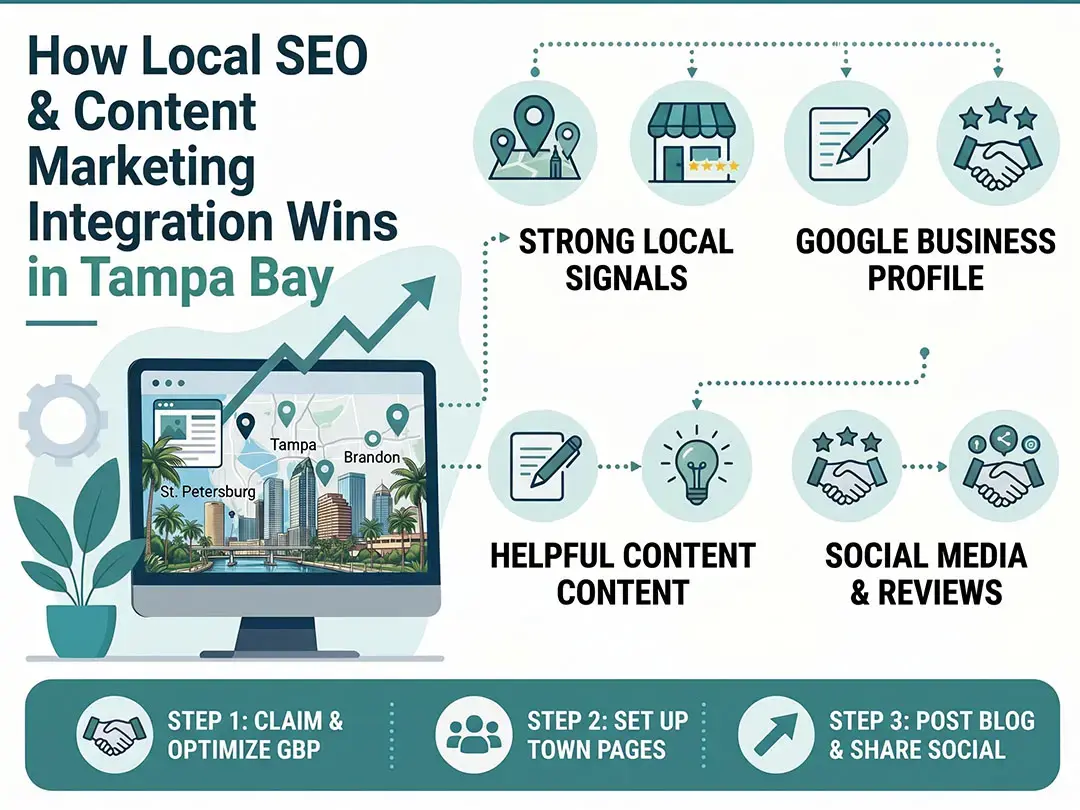
Local SEO and content marketing are two tools that work best when you use them together. Many business owners treat them as separate jobs, but the real magic happens when they meet. If you run a business, office, or service company in the Tampa Bay area, pairing smart local search with helpful content is how you get found by the people who live and shop nearby.
This guide outlines the 4 key online marketing channels, how they work, how they integrate, and the simple steps to increase calls, clicks, and customers online.
What Is Local SEO and Why It Matters for Location-Based Businesses
Local SEO means your website shares clear signals about where you do business. If your company serves Tampa, St. Petersburg, or Brandon, your pages should mention those places naturally in the spots that matter, like titles, headings, and page copy. This helps Google connect your business with people searching nearby.
The way people search for local information online is changing dramatically. When searching for a local service such as a plumber, people are now more likely to search for this on their mobile device. A search for something like “plumber near me” or “best coffee shop in Tampa” will more than likely return a map with the top 3 most relevant local businesses listed. Being listed in this top 3 map pack can mean the difference between a busy week and a slow week. Currently, without local signals, your website would rank for very broad searches, and people would not be able to find local products and services when searching online.
Finally, make sure your Google Business Profile is up-to-date. It is essential that you fill out your full address, your opening times, your phone number, and the areas you serve. Make sure you have added plenty of relevant images as well. This will help you to achieve a map pack position and also give customers all of the information they need before visiting your website. Keep this up-to-date from time to time.
What Content Marketing Brings to the Table
Content marketing is the other side of the coin to your local SEO & search engine optimization efforts to get people to your website. It is your content that does the actual selling, so ensure that it is good and helps people. It must be truthful and easy to read. Answer questions that people want to know the answer to and then describe the work that you are doing to help them. Earn their trust.
Making strong content for your website also helps to increase your ranking with Google, as it proves your online business is experienced, an expert in its field, and trusted. When sharing information about your business online, it is best to write tips, local information, and full descriptions of the services that you offer so people can see that you are not a spammer and a true, authentic online business.
How Local SEO and Content Marketing Work Together
Local search + helpful content = stronger local search + better content. To increase the power of your local search results and quality content, use your location information in your content and use your quality content to earn rankings on your location pages. Here is how.
Building a Location-Rich Website
Start with a good, solid website that clearly outlines your business in full, including products you offer and geographic location that you serve. Outline and fully detail all services offered by your business. If you serve many towns, consider setting up individual town pages, for example, a page dedicated to Wesley Chapel. Keep content simple and the website layout uncluttered so that it is easy for visitors to find what they are looking for.
Using Location Signals Like City, ZIP Codes, and Landmarks
Embed real location information into your content. Rather than just listing the cities where you have locations (and having to list each city out repeatedly), include the actual neighborhood names and corresponding ZIP codes. Also include local landmarks such as the Riverwalk, Ybor City, and the Gulf Coast beaches. Customers in nearby locations will know that you are local. Write for humans, not search engines. Include places in your content where relevant.
Blogging for Local Authority
Another great way to grow local authority is with blog posts written to answer questions that people in local areas search for, to target new keywords, and to prove knowledge of local areas. For example, a pest control company in Tampa could write about the summer mosquito season near the bay, and a roofer could write about the damage caused by recent storms in hurricane season.
Keeping Content Fresh, Relevant, and Properly Tagged
Keep your blog up to date as Google will assume most current websites are active and someone is looking after them. Add images and videos to your blog, use clear file names, and add relevant alt text to images. Also tag your pages correctly and use sufficient and relevant headings. Naturally include your business name, the services you offer, and your location in your content. Well-tagged, current, and accurate content will aid a website’s authority with Google.
The Role of Social Media in Local Content Marketing
Social media matters more than ever for local businesses. Platforms like Facebook, Instagram, and others let you connect your content to a wider crowd and start real conversations. Share your blog posts, promotions, and behind-the-scenes photos so followers like, comment, and share.
Reviews and building community trust through social media channels is also very important. Ask happy customers for a review on Google and for a follow on all of your social media pages. Reply to comments and messages in a timely manner. Supporting a local event or team and posting about it will generate a lot of goodwill with people around your store.
Smart Internal and External Linking and Avoiding Penalties
Links on your website help visitors as well as search engines to easily navigate through the site. Set up links between relevant web pages and choose an appropriate word or text to link to related services. Make sure to spell the links correctly, and they need to point to the right page.
Be wary of links to other websites. Avoid purchasing link schemes which promise immediate results. In the long run, these are not effective and can result in your site being penalized by Google. Obtain links by creating quality content, forming local partnerships, and building quality relationships with other reputable local businesses.
Putting It All Together: A Practical Local Marketing Workflow
Simple Marketing Routine To Keep Your Local Marketing On Track!
- Claim your Google Business Profile and fully complete it with photos and accurate information.
- Create clear service pages and location pages that list out the specific Tampa area towns you serve.
- Post helpful blog articles on a steady schedule.
- Link your pages together. Earn honest outside links.
- Share your content on social media and answer every single review.
Follow these steps and you set yourself up for a better marketing journey. If you want a hand getting it all done, our team offers friendly, Affordable SEO help for local businesses across the Tampa Bay area. Reach out and let us build a plan that fits your goals.
Frequently Asked Questions
What is the difference between local SEO and content marketing?
Local SEO helps bring in local customers through search and the Google map pack. Content marketing, on the other hand, creates content such as useful web pages and blog posts to inform and help build trust with potential customers. This in turn brings in customers to your physical store and converts them into paying customers.
How long does it take to see results?
You will see results within 3-6 months. Movement in local business promotion will depend upon local competition, frequency of your posts, and the completion of your Google Business Profile. In the end, honest and consistent work will yield the best results in local business promotion.
Does a small business really need a blog?
Yes. A blog can answer frequent questions, contain localized search terms, and prove your expertise in an area. Publishing a few quality articles per month can quickly establish your authority on a subject, drawing in highly targeted traffic, ready to buy.
What role does social media play in local marketing?
Messages, local conversation, and community trust: social media has a lot to offer when it comes to word of mouth. In addition to supporting reviews and engagement, social media is also one of the main factors for building up a good local reputation. On top of a good local website, social media can thus become a powerful instrument for local growth.